October 22, 2026 · Redactie
The clocks go back and your child won’t sleep? How to get bedtime back on track
The clocks go back an hour this Sunday, 25 October. Most grown ups quite like it: an extra hour in bed, at last. Anyone with small children knows it does not work like that. Children do not check the clock. They go by their own body, and on Monday morning that body is convinced that half past five is already half past six.
If your child is sleeping badly after the clocks change, or is suddenly worn out long before bedtime, you are not alone. Here is what research says about the clock change, what you can do about it, and why a steady bedtime story routine helps so much.
The extra hour of sleep barely exists
In 2013 the sleep researcher Yvonne Harrison (Liverpool John Moores University) reviewed the scientific evidence on the clock changes. Her conclusion: there is little sign of that famous extra hour of sleep on the night the clocks go back. In the days that follow, people actually wake earlier, and across the whole week they end up with less sleep, not more. The body does not adjust overnight, she writes, and the adjustment is not without consequences.
Young children live by a tight rhythm, and parents will recognise the picture at once. Seven o’clock in the evening now feels like eight to your child. Five in the afternoon feels like six, exactly when they were tired and hungry the week before. The result: a child flagging at the dinner table, an evening that ends in tears and a morning that starts far too early.
How to help your child through the clock change
- Shift in small steps. Because the body does not switch over in one night, you can spread the hour out. In the days before 25 October, put your child to bed about a quarter of an hour later each evening. Once the clocks have gone back, they will be right back at their usual bedtime.
- Keep the routine the same. Bath, pyjamas, teeth, book, lights out. In a large study of mothers of more than ten thousand children aged 0 to 5, across thirteen countries and regions, a consistent bedtime routine went hand in hand with earlier bedtimes, falling asleep faster, waking less in the night and sleeping longer. The more often the routine was followed, the better the results (Mindell and colleagues, 2015).
- Keep the lights low in the last hour. In children aged 3 to 5, an hour of bright light just before bedtime suppressed the sleep hormone melatonin by almost 90 per cent on average, and for most of them the effect had still not worn off nearly an hour later (Akacem and colleagues, 2018). It was a small study, but the message is clear: a bedside lamp for story time beats the big light.
- Make the morning start later. Keep the curtains closed until the time your child would normally get up, so the early hours do not feel like daytime straight away.
Darker evenings are an opportunity
There is good news as well. In summer it is still light at eight o’clock, and it is hard to explain why it is time for sleep. Once the clocks have gone back, it is already dark outside when your child goes to bed.
So this is a good moment to start a habit, or pick up an old one: a story every night. It does more than close the day. In a 2018 review, Jodi Mindell and Ariel Williamson (Children’s Hospital of Philadelphia) describe how the regular parts of a bedtime routine, such as reading and singing together, are linked not only to better sleep but also to language development, literacy and the bond between parent and child.
A bedtime story about a child who cannot sleep
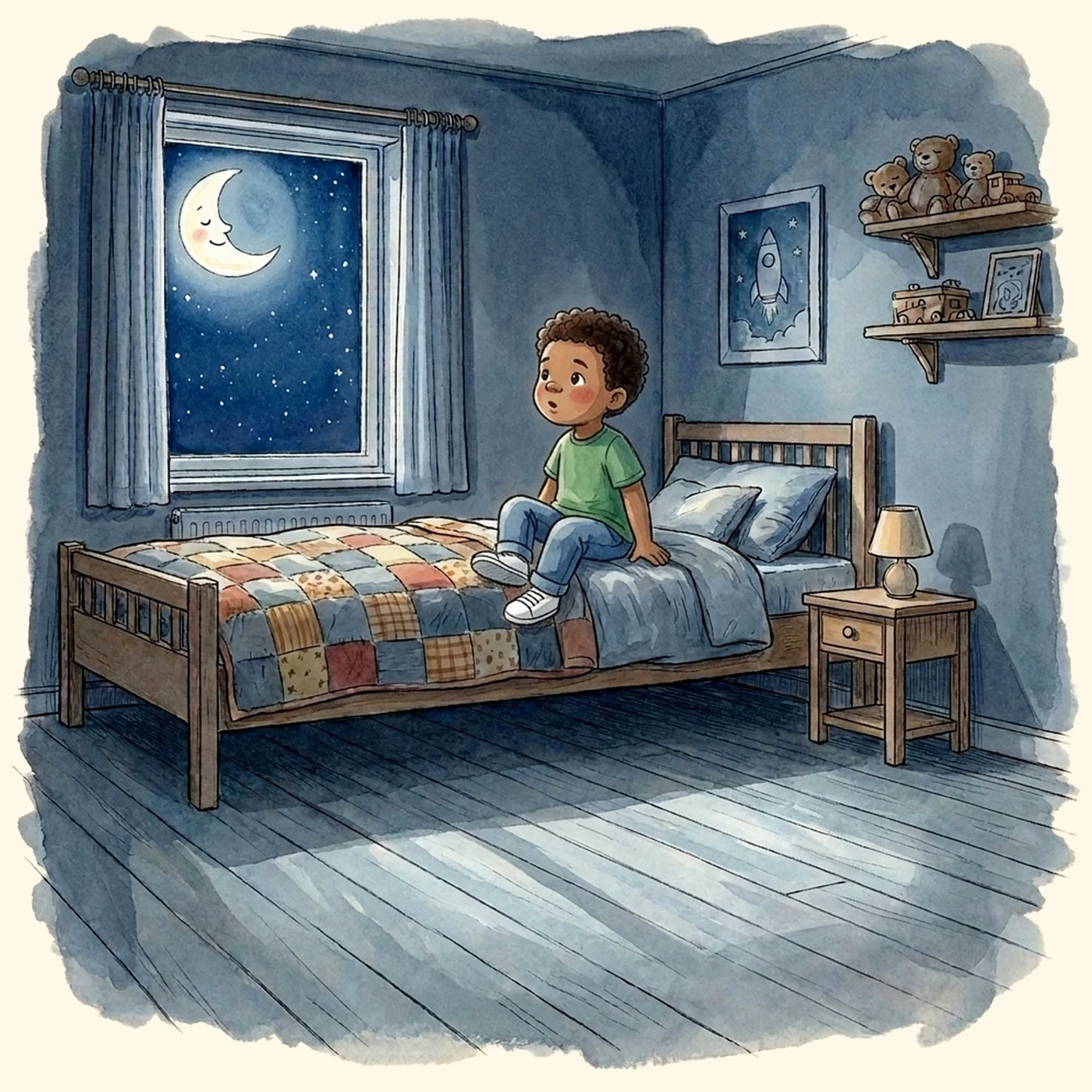
At Kids Chapters we have a book that fits this time of year rather well. In The Secret of the Moon, your child cannot get to sleep. It is far too bright, because the moon is shining in between the curtains. But it is only half a moon. Why is that?
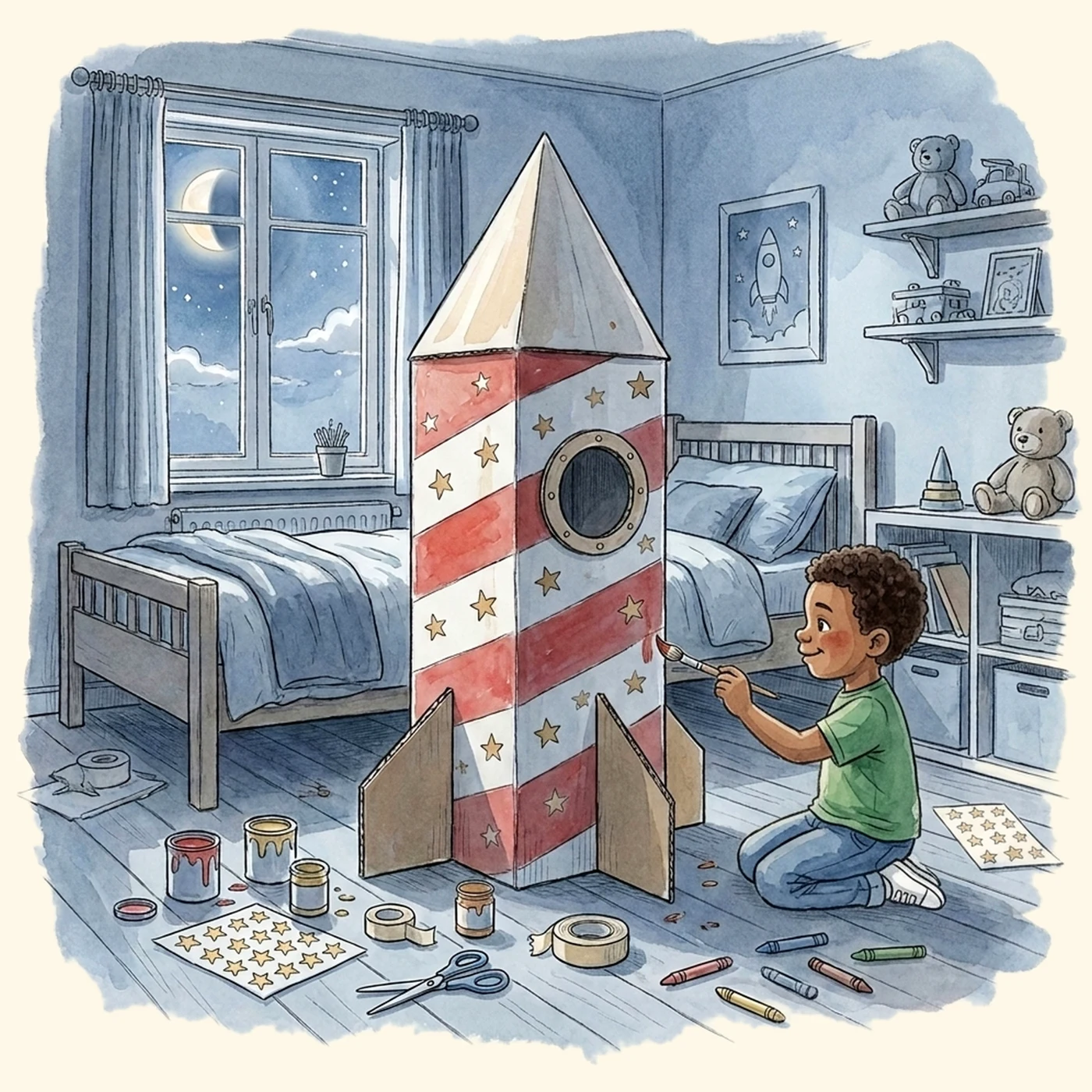
Your child builds a rocket from a big cardboard box, covers it in star stickers and flies off to the moon. Up there a small silvery white rabbit is crying: his moon lanterns have gone out. Together they catch stardust in a jar and fill the lanterns, until the moon is a sea of little lights again. At the end your child slips back into bed, with a jar of moonlight glowing on the bedside table.
The story starts with a little excitement and grows softer as it goes. The last pages are quiet and warm, and the very last words wish your child goodnight by name. It takes your child on an adventure and then brings them gently back to bed.
Your child in the story
The Secret of the Moon is a personalised children’s book. You type in your child’s name and upload a photo, and your child appears as an illustration in the pictures. Their name is on the cover and in the story. The book is for children aged 3 to 9, and it is a 21 x 21 cm hardback, printed in the Netherlands.
Perhaps the nicest part comes after the book is closed. When your child looks out of the window at the moon, they know exactly who is waving down at them.
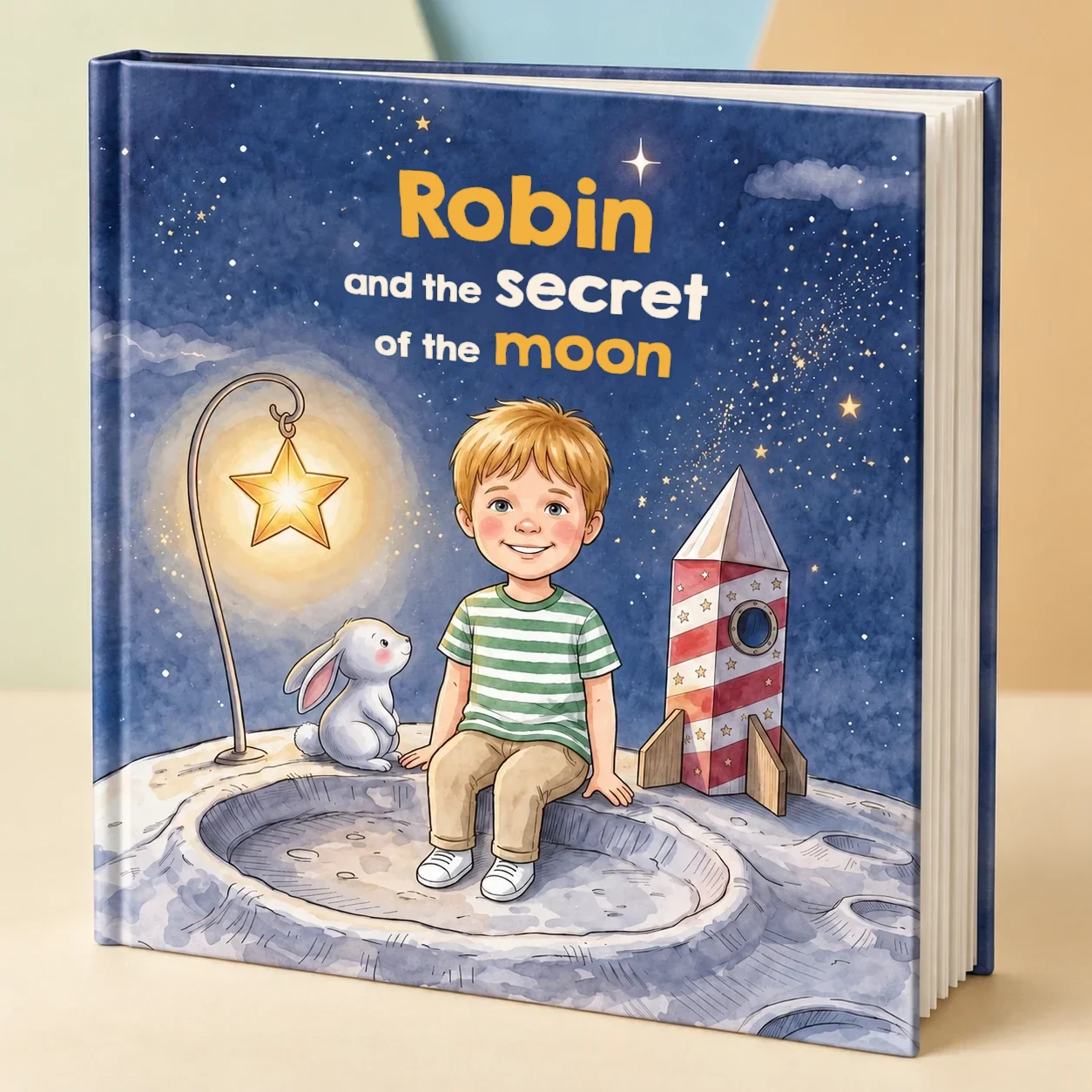
Would you like to see it first? You can leaf through the whole book before you add your child’s name. Or browse all Kids Chapters books and choose the story that suits your evenings.
Sources
- Harrison, Y., The impact of daylight saving time on sleep and related behaviours, Sleep Medicine Reviews, 17(4), 285-292, 2013.
- Mindell, J.A., Li, A.M., Sadeh, A., Kwon, R. and Goh, D.Y., Bedtime routines for young children: a dose-dependent association with sleep outcomes, Sleep, 38(5), 717-722, 2015.
- Mindell, J.A. and Williamson, A.A., Benefits of a bedtime routine in young children: sleep, development, and beyond, Sleep Medicine Reviews, 40, 93-108, 2018.
- Akacem, L.D., Wright, K.P. and LeBourgeois, M.K., Sensitivity of the circadian system to evening bright light in preschool-age children, Physiological Reports, 6(5), e13617, 2018.