August 7, 2026 · Lisa, content editor
A Personalized Children's Book for Bilingual Kids: Growing Up in Two Languages
By Lisa, mother of two and content specialist at Kids Chapters
In our house, two languages run alongside each other all day long. My in-laws speak Spanish, we speak Dutch, and our four-year-old switches between them without giving it a second thought. Still, parents keep asking me the same question: how do I keep the second language alive once my child starts school and the majority language is suddenly everywhere? A personalized children''s book for bilingual kids turns out to be a surprisingly effective answer, and here is why.
Why a personalized children''s book helps bilingual kids
Children do not learn a language from a worksheet. They learn it from moments that mean something: the song grandma always sings, the word dad uses when he laughs, the sentence that comes back every night at bedtime. Language sticks where feeling is attached.
That is exactly where a story starring your own child becomes powerful. The name on the page is their name. The adventure belongs to them. Those words stop being an exercise and start being personal. Research on language acquisition consistently shows that children absorb vocabulary faster when they are emotionally engaged, and a book about yourself simply lands harder than a book about a rabbit you have never met.
For bilingual families there is an extra layer. The minority language, the one not heard at school or in the playground, tends to get squeezed out. Kids still understand it but speak it less and less. A book they genuinely love and ask for again and again gives that language a warm, dependable place in the week.
One parent, one language, one book that bridges both
The best known approach to raising bilingual children is the one-parent-one-language method: each parent consistently sticks to their own language. It works because the child links a language to a person, which makes the two easier to keep apart.
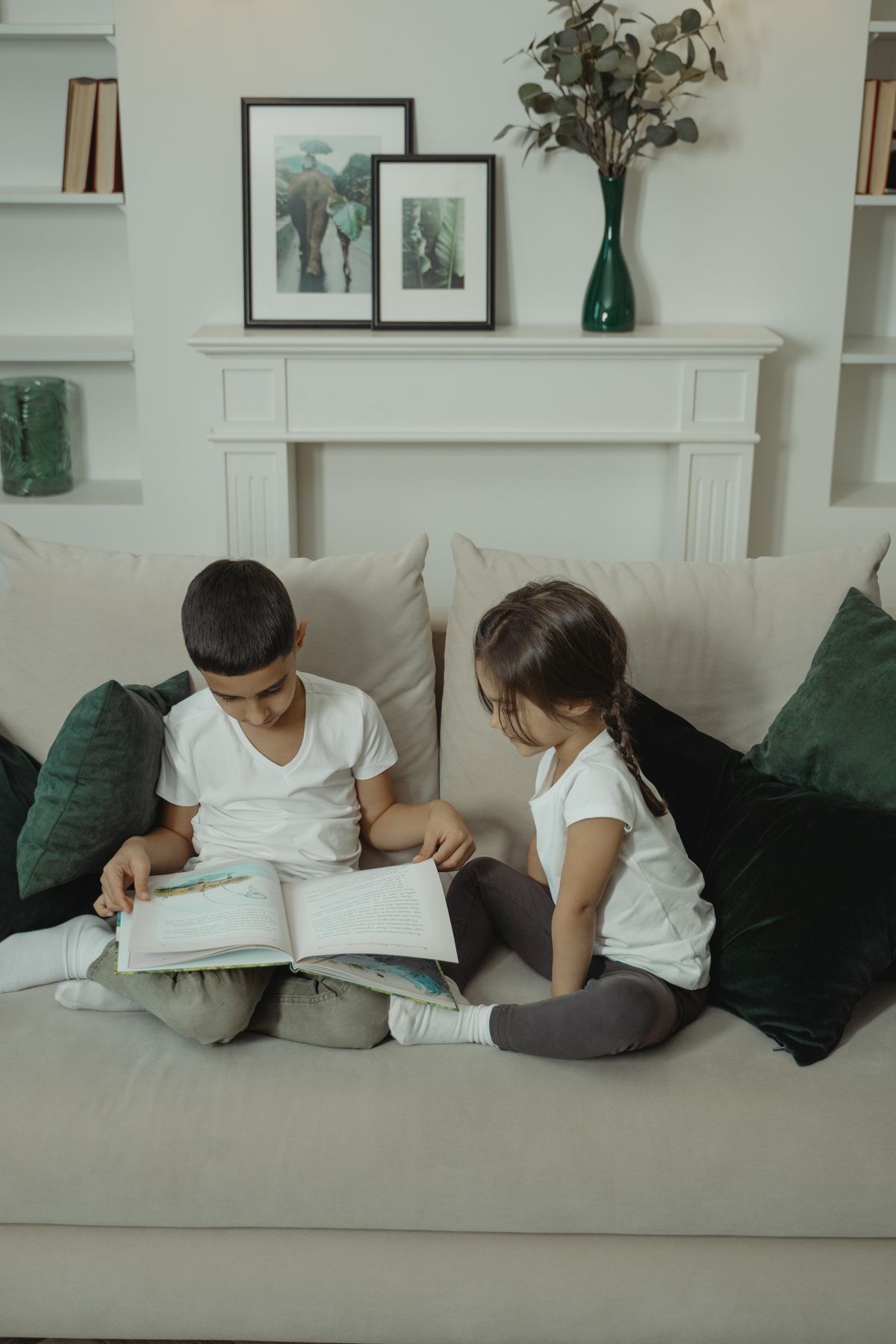
What many parents do not realise is how much reading aloud strengthens that method. When the minority-language parent reads in that language every evening, a small daily ritual forms in which the language is simply normal. No pressure, no lesson, just the two of you on the sofa with a story. And when the story is about your own child, they usually want it three times in a row. That repetition is precisely what grows vocabulary.
One practical tip that worked well for us: do not let the second language stop at reading. After a page, ask your child what they think happens next, in that language. Listening quietly turns into speaking.
What to expect, and what not to
Let us be honest: growing up bilingual rarely follows a straight line. There will be stretches where your child answers only in the majority language, no matter which one you use. Some children blend both languages inside a single sentence. Both are completely normal and both usually pass on their own.
What helps is staying calm and never forcing it. The moment a language feels like an obligation, children pull away. Up to around age seven they pick up two or even three languages relatively easily, but only while it stays enjoyable. So offer the language in as many forms as you can: talking, singing, games, audiobooks and of course reading together.
Do not expect one book to change everything either. What it does is give you a reason. Something your child asks for, rather than something you have to impose. For plenty of parents struggling to keep a second language going, that is exactly the nudge that was missing.
Fitting the book into your routine
Start small. Pick one fixed moment a day, ideally at bedtime, and keep it going for a few weeks. Let your child help choose when possible, because having a say lifts engagement enormously. Read slowly, point at words, and feel free to skip a page when attention drifts.
And leave the book somewhere visible. Children reach for what they can see, and a book with their own name on the cover rarely ends up at the bottom of the pile.
At Kids Chapters we create personalized children''s books in which your child is the main character, with their own name and their own adventure. For families where two languages meet, it is a lovely way not just to maintain a language but to genuinely enjoy it. Curious what such a story looks like? Have a look around at kidschapters.com and see what is possible.
Two languages are not a double burden. They are two ways of understanding the world, and two ways of saying goodnight.