September 8, 2026 · Bas, co-founder
Why AI Cannot Write a Good Children's Book
You type in a name, pick a theme, click a button, and thirty seconds later there is a finished children's book. It sounds wonderful, and plenty of companies now offer exactly that. Yet parents keep telling me the same thing once the book arrives. It looks neat, their child is in it, and after one read-aloud nobody picks it up again. A fully AI-generated children's book is usually missing something you cannot quite point at but feel straight away. A soul.
That is not just a feeling. Researchers have started looking into it, and the findings all point the same way.
What an AI-generated children's book is missing
In October 2025, the ELT Journal, published by Oxford University Press, carried a study in which eleven parent and child pairs read AI-generated stories together. The children were between three and nine. The parents all said roughly the same thing: the stories lacked dramatic arc, humour and charm, and compared badly with the books they already knew.
The telling part came from the children. Several of them could not say what had happened in their own story afterwards.
That is the real problem. It is not that the sentences are bad, because usually they are fine. The problem is that there is no story. A language model assembling a book to order puts one event after another, each of them sensible on its own, none of them building towards anything. There is no moment where it gets genuinely exciting. No joke that comes back later. No character who works something out halfway through. Your child listens politely and remembers nothing, because there is nothing to remember.
The researchers also noticed that ordinary storytelling devices were missing. Little dialogue, little humour, little repetition. Those are exactly the things that help children guess what is coming, pick up new words and feel involved. Their conclusion was measured: stories like these can be a fun extra, but they should not take the place of books written by people.
Ask for rhyme and you get filler
There is one thing you hear immediately, and that is rhyme. Ask a generator for a rhyming story and you get something that works on paper but stumbles out loud.
It comes down to how these models work. They do not read language as sound, they read it as pieces of text. A model has no built-in sense of a syllable and does not know where the stress in a word falls. Researchers at the University of Crete showed this clearly in a study of Greek poetry. When they asked a language model for a poem with a fixed rhyme scheme, fewer than four percent of the results were actually correct. Only once they added a separate program that checked the sounds did that climb to 73 percent. The models were picking words that looked like they rhymed on the page while sounding nothing alike.
That study covered strictly built Greek verse, so you cannot transfer those percentages straight onto a picture book. But the cause is not specific to Greek, it sits in the technology itself.
Ask a generator for a rhyme to go with a letter and you usually get something like this:
The F is for Flamingo, standing still in the lake,
His feathers are pink and pretty, what a lovely sight to make.
Nothing is obviously wrong with it, and that is exactly the problem. It rhymes and you can read it aloud. But the second line says nothing. "What a lovely sight to make" is there because it rhymes with "lake". Your child hears that a flamingo is pink, which it already knew.
Now put two lines from our alphabet book beside it. That book is Dutch, and it builds up to your child's full name with an animal for every letter:
De F is van Flamingo, een echte exoot,
Die wordt grijs geboren, maar wordt roze groot.De L is van Luipaard, geen paard en niet lui,
Je zult hem nooit vinden in een luxe fauteuil.
You do not need Dutch to see what is going on. The first pair says a flamingo is born grey and only turns pink later, from what it eats. That is true, and most children have never heard it. The second is a joke: the Dutch word for leopard, luipaard, happens to contain lui, meaning lazy, and paard, meaning horse. The line points out that the animal is neither, and then refuses to let him sit in a luxury armchair.
Notice what happens if you translate that second couplet into English. The joke disappears, because it never lived in the meaning, it lived in the word itself. Which is rather the point.
A language model can make two lines rhyme, that is not the issue. The issue is that all of it has to work at once: the rhythm, a pun that exists only in one language, and a fact that also happens to be true. And then again for every letter of the alphabet without getting dull. That is where a generator gives way, and you get lines like the first one, where the rhyming word decides what gets said instead of the other way round.
Children hear that difference unerringly, even if they cannot explain it. With the first version they listen politely. With the second they ask you to do it again.
A different child on every page
The second thing you notice once the book is on the table is the pictures. Image generators make each one separately from the last. Your daughter's hair sits differently on page three than on page four, her coat changes colour, and by the final page it is really a different child. The Oxford study mentions this too: illustrations that failed to show what the story was actually about at that moment, or that added objects out of nowhere.
To an adult that is a small blemish. To a four-year-old it takes the floor out from under the book. The whole idea of a book where you are the main character is that it is you, the entire way, from the first page to the last.


Then there is the style itself. Line up a lot of these books and you see the same two flavours over and over: a glossy animated-film look, or something in the direction of anime. That makes sense, because it is where image models drift by default when nobody gives them a direction of their own. It is recognisable, but it is the recognisability of a template.
Nobody proofread it for you
With an ordinary children's book there is a whole chain of people between the writer and the bedside table. An editor, a designer, a publisher, a bookseller. They take things out along the way, from clumsy sentences to things you would rather not read to a five-year-old. With a book that only comes into existence the moment you order it, that chain is missing. You are the first human being to read it, usually out loud, with your child on your lap.
That goes wrong more often than you would think. In the Netherlands, the weekly De Groene Amsterdammer worked with the Data School at Utrecht University to examine what was on sale at the country's biggest online bookshop. They found more than 6,500 titles largely or entirely written by AI, better than one in every 25 books. Their verdict on the texts: empty of meaning, badly written and repetitive. That research covered non-fiction for adults rather than children's books, so it mostly tells you how fast this is moving. But it shows what happens once nobody is checking any more.
With children's books there is something else on top. Researchers at Macquarie University warn that clichés and stereotypes slip unnoticed into both text and images, and that young readers cannot yet spot them. They also point out that many of these services take photographs of your child without making clear where those photographs end up afterwards.
Reading aloud is about repetition
There is one more reason an endlessly generatable book works against itself, and it has nothing to do with technology. Children want the same book. Forty times. They want to know what is coming, they want to finish the sentence they already know by heart, they want you to do that one silly voice again.
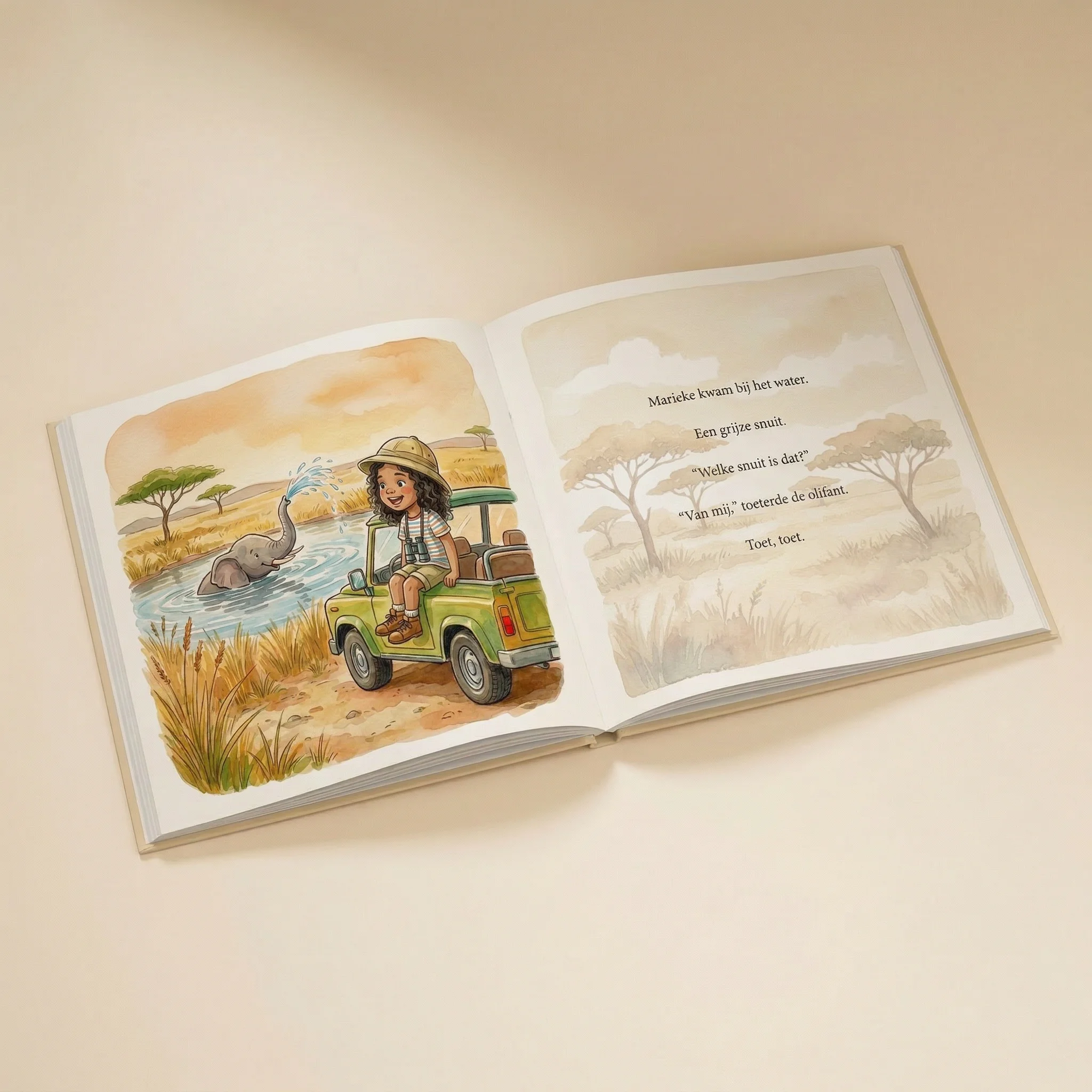
That is why our safari book for the very youngest has a line that keeps coming back. "Whose snout is that?" First it is the rhinoceros, then the lion, then somebody else. Toddlers work out the pattern after two goes and are shouting it along by the third animal. That is not an accident, it is the reason the line is there. Something like that does not come out of a generator, because a generator does not know you are going to read this book another forty times.
A story that appeared in thirty seconds rarely invites that. It is new, it is theirs, and by the next day it is forgotten. The books that get read to pieces are nearly always the ones somebody thought about for a long time.
How we do it, and where we do use AI
I want to be straight about this, otherwise none of the above is worth much. We use AI too. Just not for the story.
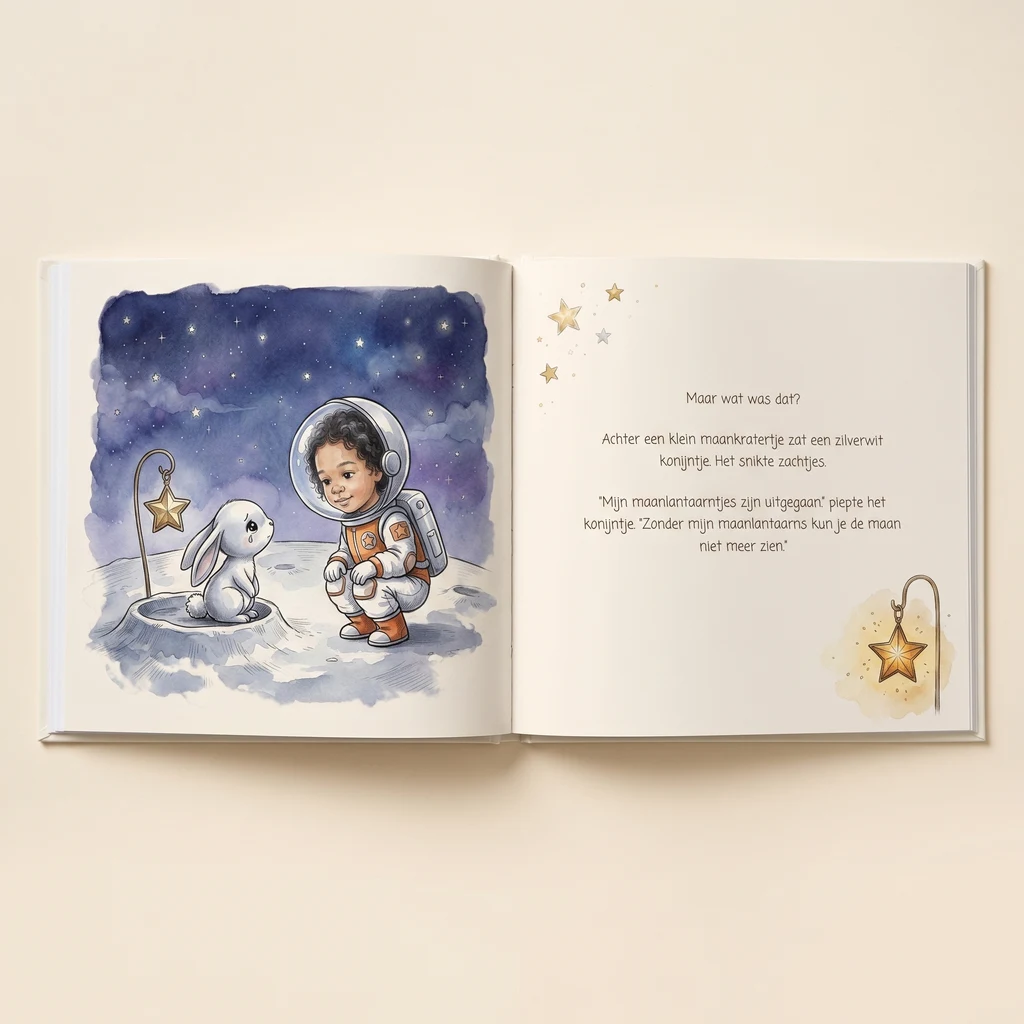
Our stories are written by people. They exist before you order anything. They are built as real stories, with a problem that has to be solved. In our newest book your child helps the moon rabbit relight the lanterns, so that people back on earth have a little light in the dark again. They are matched to age and reading level, and every story is written and tested before it goes on sale. That approach is not just our own preference: it won us silver at Renew the Book 2026. So somebody has read it before you open it.
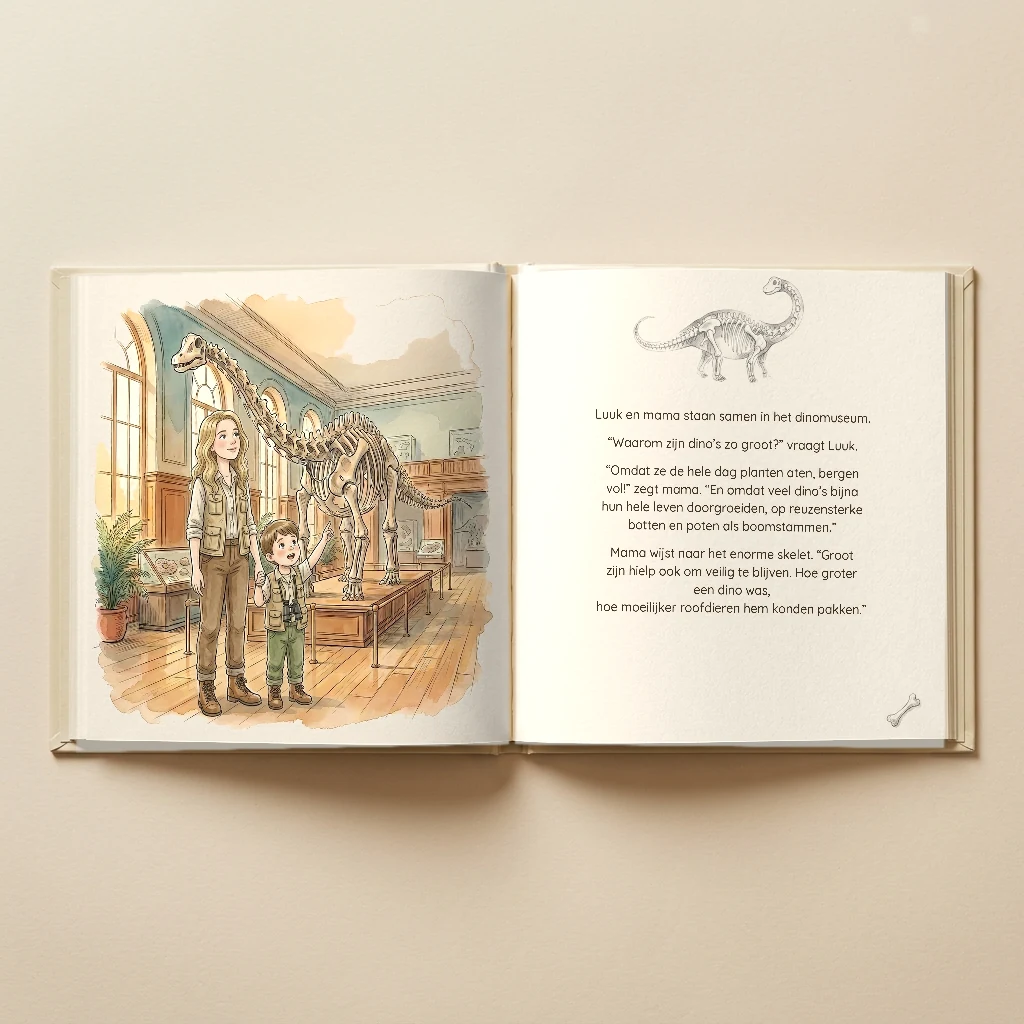
Where we do use AI is the artwork. We developed our own watercolour drawing style, and we use AI to apply that style to your child, so that it is recognisably your child inside our illustrations. That is a different thing from letting an image generator do as it pleases. You see the difference at once: no anime, no animated-film gloss, just one calm style that holds up across the whole book.
| Kids Chapters | Fully AI-generated | |
|---|---|---|
| The story | Written by people, building towards a high point | Assembled per order, often without a real plot |
| Editing | Written and tested before it goes on sale | You are the first to read it |
| Illustration style | Our own watercolour style, consistent throughout | Varies page by page, often anime or animated film |
| Your child | Looks the same on every page | Face and clothes change along the way |
| Reading level | Matched to age and reading ability | Rarely matched to anything in particular |
| Reading aloud | Written to be repeated often | Made to surprise you once |
I am not saying AI has no place in children's books. We use it ourselves, and it makes something possible that used to be unaffordable. But there is a difference between using technology to help a story land with a child, and letting technology invent the story. The first gives you a book that gets read to pieces. The second gives you a file.
If you want to see what that difference looks like in practice, have a browse through one of our books at kidschapters.com. Read the opening pages out loud. That is where you hear fastest whether somebody actually wanted to tell a story.
Sources
- Sara Ratner, Cindy Ong, Sandra Mathers and Victoria A. Murphy, 'Did a robot write that?': AI-generated digital storybooks, ELT Journal 79(4), Oxford University Press, October 2025.
- Stergios Chatzikyriakidis and Anastasia Natsina, LLMs Got Rhythm? Hybrid Phonological Filtering for Greek Poetry Rhyme Detection and Generation, University of Crete, 2026.
- Eva Hofman and Joris Veerbeek, Slecht geschreven! Niet kopen!, De Groene Amsterdammer, 5 June 2024.
- Daozhi Xu, Bedtime stories by ChatGPT? The AI children's book boom explained, Macquarie University, May 2026.